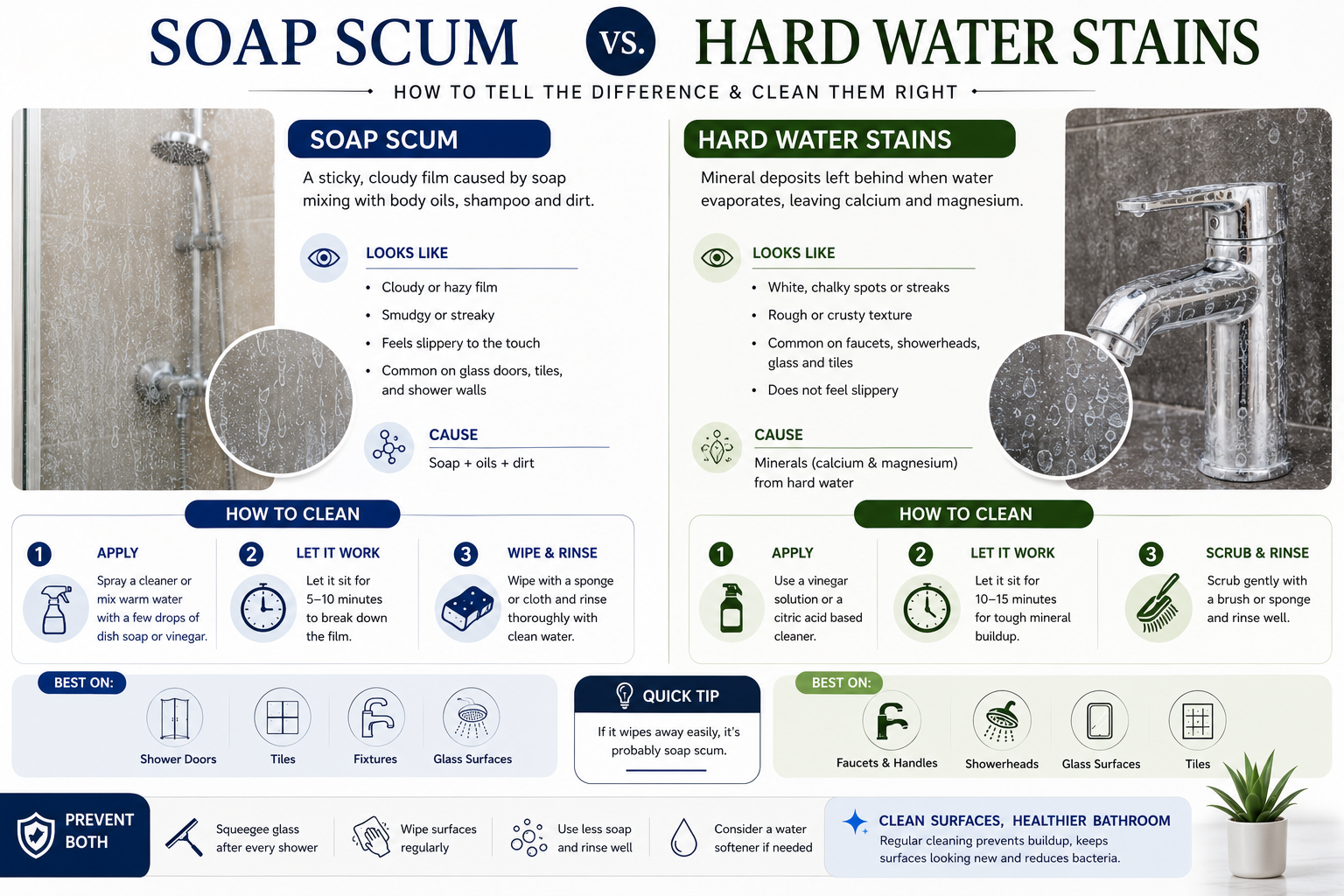
Soap Scum vs Hard Water Stains: How to Tell the Difference
Introduction
Many bathroom stains look similar at first glance, especially when they collect on shower walls, glass doors, taps, and tiled corners. Homeowners often scrub the same spot repeatedly with the wrong product and wonder why the mark does not disappear. In most Indian bathrooms, the two most common culprits are soap scum and hard water stains.
They are related, but they are not the same problem. Soap scum is a residue formed when soap mixes with minerals and body oils. Hard water stains are mineral deposits left behind when water dries. Knowing the difference matters because the right cleaner depends on the stain type, the surface, and how long the residue has been sitting there.
Quick Answer
Soap scum is a cloudy, greasy film that forms when soap reacts with minerals and body oils. Hard water stains are chalky white or cloudy mineral deposits left after water evaporates. Soap scum usually feels slippery or waxy, while hard water stains feel dry, rough, or crusty. Use a degreasing bathroom cleaner for soap scum and a descaler or acid-based cleaner for mineral stains on compatible surfaces.
Key Takeaways
- Soap scum is a film made from soap residue, oils, and minerals.
- Hard water stains are mineral deposits, mostly calcium and magnesium.
- Soap scum feels greasy or waxy; hard water stains feel dry and chalky.
- Soap scum responds better to surfactants and degreasers.
- Hard water stains need descaling agents or mild acids on safe surfaces.
- Misidentifying the stain can waste time and damage delicate surfaces.
- Prevention is easier than removal: drying, ventilation, and regular wiping help a lot.
Table of Contents
- What is soap scum?
- What are hard water stains?
- Soap scum vs hard water stains: side-by-side comparison
- How to test which stain you have
- Best cleaning methods for each stain
- Common mistakes
- Prevention tips
- FAQ
- Conclusion and Hyginox recommendation
What is soap scum?
Direct Answer: Soap scum is a sticky or cloudy residue that forms when soap reacts with minerals in water and mixes with oils, skin cells, and everyday bathroom grime. It commonly builds up on shower walls, bathtubs, glass doors, and fixtures where soap and water are used repeatedly.
Soap scum is usually most visible after frequent bathing or when liquid soap, bar soap, and shampoo residue are left to dry on wet surfaces. In homes with harder water, the residue forms faster because the minerals in the water help soap turn into a film instead of rinsing away completely.
You may notice soap scum as:
- A cloudy or hazy film on glass
- A dull, slightly greasy layer on tiles or tubs
- A white or off-white buildup around tap zones and soap holders
- A surface that feels slippery, waxy, or tacky when wiped
What are hard water stains?
Direct Answer: Hard water stains are mineral deposits left behind when water evaporates and the calcium or magnesium it contains remains on the surface. They usually show up spots, chalky rings, cloudy patches, or crusty deposits on tiles, glass, taps, and shower fittings.
These stains are common in homes that receive mineral-rich water from municipal supply lines, borewells, or tank storage systems. When water repeatedly splashes and dries on the same area, it gradually leaves behind a stronger deposit that becomes harder to clean with each cycle.
You may notice hard water stains as:
- White or cloudy deposits on glass and chrome
- Rough, chalky residue on tile edges or shower screens
- Mineral crust around taps, faucets, and nozzles
- Dry deposits that do not feel greasy
Soap scum vs hard water stains: side-by-side comparison
Direct Answer: Soap scum is a film made from soap and oils, while hard water stains are mineral deposits left after evaporation. If the mark is greasy, smudgy, or wipes away with a degreaser, it is likely soap scum. If it looks chalky, crusty, or needs a descaler, it is likely hard water buildup.
| Feature | Soap Scum | Hard Water Stains |
|---|---|---|
| Cause | Soap residue + minerals + body oils | Minerals left behind after water dries |
| Look | Cloudy, dull, greasy, film-like | White, chalky, crusty, cloudy spots |
| Feel | Slippery or waxy | Dry, rough, or gritty |
| Best cleaner | Bathroom cleaner, degreaser, surfactant-based formula | Descaler, mild acid, mineral remover |
| Common surfaces | Shower walls, tubs, doors, soap trays | Glass, taps, tiles, faucets, shower screens |
| Prevention | Rinse soap residue, improve ventilation, wipe down after use | Dry wet surfaces, use squeegee, reduce standing water |
How to test which stain you have
Direct Answer: The simplest test is to wipe the area with a damp microfiber cloth and a small amount of bathroom cleaner. If the residue lifts easily and feels greasy, it is likely soap scum. If the mark remains chalky or rough, it is probably hard water buildup and needs a descaler.
For a quick at-home check, use these tests in sequence:
- Wipe with a damp cloth. If the mark smears or feels slick, suspect soap scum.
- Apply a mild bathroom cleaner. If it improves, soap scum is likely a big part of the problem.
- Apply a small amount of diluted vinegar only on compatible surfaces. If the white crust softens, mineral deposits are likely present.
- If the surface is marble, limestone, travertine, or another acid-sensitive material, avoid vinegar and use a pH-neutral stone-safe cleaner instead.
In many bathrooms, both stains appear together. Soap scum can trap hard water minerals inside it, which makes the mark feel thicker and more stubborn. That is why a layered cleaning approach often works best.
Why they form in Indian bathrooms
Direct Answer: Indian bathrooms often see faster buildup because of frequent bathing, harder water in many regions, limited drying time, and repeated soap use on wet surfaces. When surfaces stay damp for long periods, both soap residue and mineral deposits have more time to settle and harden.
Apartment bathrooms, family homes, and shared bathrooms can all develop the same issue, but the buildup pattern changes slightly. A high-use family bathroom may show soap scum on shower walls and glass first, while a bathroom with hard borewell water may show mineral spots on taps and tiles more quickly. Good cleaning habits matter more than the source of the water alone.
Best cleaning methods for soap scum
Direct Answer: Soap scum responds best to surfactants and mild degreasers that break up oily residue and let water rinse it away. A dedicated bathroom cleaner works faster than a general-purpose detergent because it is made to cut through film on wet-room surfaces.
Use this process for typical soap scum on tiles, tubs, and glass:
- Spray or apply bathroom cleaner to the affected surface.
- Let it sit for a few minutes so the film softens.
- Wipe with a microfiber cloth or soft sponge.
- For stubborn corners, use a soft brush or non-scratch pad.
- Rinse and dry the surface so residue does not return quickly.
For light soap scum, a diluted vinegar solution may help on compatible surfaces, but bathroom cleaner is usually safer and more repeatable for regular maintenance. If the stain is heavy or layered with mineral deposits, you may need two passes: a degreasing pass first and a descaling pass second.
Best cleaning methods for hard water stains
Direct Answer: Hard water stains need a descaling method that dissolves mineral deposits rather than just lifting surface dirt. A bathroom descaler, citric acid solution, or tile-safe mineral remover usually works better than a standard soap-based cleaner.
Use this process for mineral marks on tile, taps, and glass:
- Apply a descaler or mineral remover to the stained area.
- Allow sufficient dwell time so the minerals soften.
- Use a soft cloth, sponge, or brush depending on the surface.
- Rinse thoroughly to remove loosened minerals and cleaner residue.
- Dry the surface completely to prevent new deposits from forming.
For glass doors and faucets, the visual result is usually immediate once the mineral film breaks down. For textured tile or grout, the process may need a second application because the deposits sit deeper in the surface grooves.
When vinegar helps and when it should be avoided
Direct Answer: Vinegar can help with light soap scum and fresh hard water spots on glazed tile and glass, but it should be avoided on marble, limestone, travertine, and other acid-sensitive stone. Using vinegar on the wrong surface can etch and dull the finish.
Vinegar is useful when the buildup is light and the surface is non-porous. It works because the acidity helps loosen minerals and break down thin films. But it is not a universal answer. On natural stone, the same acidity can damage the surface faster than it cleans it.
| Surface | Vinegar Safe? | Better Option |
|---|---|---|
| Glazed ceramic tile | Usually yes, for light buildup | Bathroom cleaner or diluted vinegar |
| Glass shower doors | Usually yes | Glass-safe descaler or diluted vinegar |
| Chrome taps | Usually yes, with quick rinse | Descaler or vinegar wipe |
| Marble or limestone | No | pH-neutral stone cleaner |
How to avoid using the wrong cleaner
Direct Answer: Choose the cleaner by the stain type and the surface material. Use a degreasing bathroom formula for soap scum, a descaler for mineral deposits, and a pH-neutral cleaner for delicate stone. When in doubt, test a hidden spot first.
A wrong cleaner can do one of three things: waste time, leave the stain unchanged, or damage the surface. For example, a soap-based cleaner may make a mineral stain look temporarily better without actually dissolving it. Likewise, an acid-based cleaner may etch a stone surface while barely affecting greasy residue. The safest approach is to identify the stain before you clean.
Common mistakes
Direct Answer: The most common mistakes are using one cleaner for every stain, scrubbing too hard, and treating a mineral stain like a grease stain. These mistakes can scratch surfaces, waste effort, and make buildup harder to remove later.
- Using a random all-purpose cleaner on every bathroom mark
- Scrubbing glass or tile with rough pads
- Leaving cleaner on too long without checking surface compatibility
- Ignoring water drying time after bathing
- Mixing acidic cleaners with bleach or ammonia
Prevention tips
Direct Answer: Prevention is mostly about drying, ventilation, and routine wiping. If you stop soap residue and mineral-rich water from sitting on the surface, both soap scum and hard water stains become much less likely to build up.
- Use a squeegee on shower glass and wall panels after bathing.
- Wipe taps, mirrors, and splash zones with a microfiber cloth.
- Keep the exhaust fan running long enough to reduce humidity.
- Do a weekly bathroom clean before buildup hardens.
- Use the right amount of soap so residue is easier to rinse away.
- If water is very hard, clean more frequently and descaling should become part of the routine.
People Also Ask
Is soap scum the same water stains?
No. Soap scum is a film made from soap residue and oils, while hard water stains are mineral deposits left when water dries. They can appear together, which is why they are often confused.
What removes soap scum fastest?
A bathroom cleaner with surfactants or a mild degreasing formula usually removes soap scum faster than plain detergent. Let it dwell briefly, then wipe with a microfiber cloth.
What removes hard water stains fastest?
A descaler or mineral remover works fastest on hard water stains. On compatible surfaces, mild acids like citric acid can also help loosen deposits.
Why do my bathroom walls get cloudy?
Cloudy bathroom walls are usually a mix of soap scum and mineral residue. The cloudiness gets worse when surfaces stay wet and are not wiped down regularly.
Can I use the same cleaner for both stains?
Sometimes a bathroom cleaner can handle both light soap scum and light mineral film, but heavy buildup usually needs the right chemistry for each stain. Degrease first if the surface feels greasy, then descale if the mark stays chalky.
Does hard water cause soap scum?
Yes. Hard water makes soap scum form faster because the minerals react with soap and reduce its ability to rinse cleanly. That is why bathrooms with hard water often need more frequent cleaning.
When professional help may be needed
Direct Answer: Professional help may be needed when stains are deeply set into grout, when mineral crust has built up for months, or when the bathroom uses natural stone that should not be cleaned with acids. Restoration experts can clean safely without damaging the finish.
If repeated cleaning does not change the appearance, the issue may be more than a surface stain. In some cases the grout needs resealing, the glass has etched from years of buildup, or the water quality is contributing too heavily to the problem. At that point, professional restoration or a better water-treatment solution may be the practical next step.
Hyginox recommendation
For Indian bathrooms that deal with both soap residue and recurring water marks, a dedicated bathroom cleaner is usually more practical than switching between multiple home mixes. Hyginox Bathroom Cleaner is a natural fit for regular maintenance because it helps manage soap scum, light mineral buildup, and everyday bathroom grime in one routine.
Conclusion
Soap scum and hard water stains may look similar, but they need different cleaning strategies. Soap scum is oily and film-like, while hard water buildup is mineral and chalky. Once you know which one you are dealing with, the cleaning job becomes much simpler and the results are usually better.
For the best outcome, match the stain to the right cleaner, avoid unsafe chemistry on delicate surfaces, and build a drying routine into everyday bathroom care. That approach saves time, reduces scrubbing, and keeps the bathroom looking cleaner for longer.
CTA
If your bathroom deals with both soap scum and hard water marks, use a purpose-built cleaner for the specific surface and stain type. For regular upkeep, consider a dedicated bathroom formula that makes daily maintenance easier and more consistent.