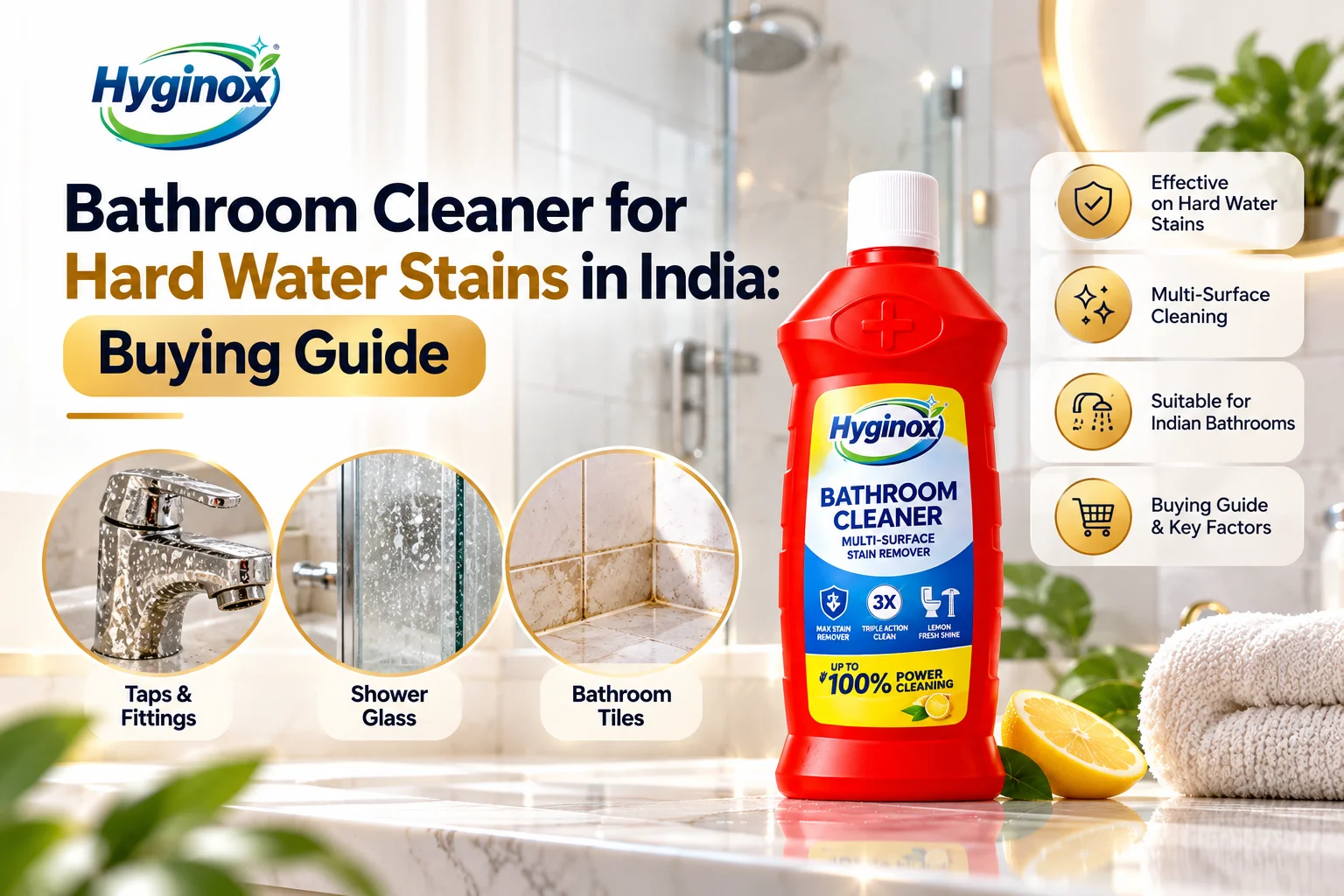
Looking for a bathroom cleaner for hard water stains can be confusing when white patches keep returning on tiles, dull marks appear around taps, or shower glass looks cloudy soon after cleaning. The key is to identify the residue first: everyday grime, soap scum and mineral scale are different problems, and not every bathroom cleaner is designed for all three.
This guide explains what to check before buying a bathroom cleaner in India, how to match a product to the surface, and how to use it without unnecessary scrubbing or damage. It also explains when light water marks may respond to a routine cleaner and when a purpose-made descaler may be needed.
Quick answer: what should you look for?
Choose a bathroom cleaner that specifically lists the stains and surfaces you need to clean. A bathroom cleaner for hard water stains should clearly state which deposits and surfaces it is designed for. For soap scum, everyday grime and light water marks, a suitable bathroom cleaner may be enough. For heavy mineral scale, look for explicit limescale or hard-water deposit guidance. Always follow the label, test a hidden area, rinse thoroughly and never mix cleaning products.
Why hard-water stains appear in Indian bathrooms
Hard water contains dissolved minerals, mainly calcium and magnesium. When water splashes onto a surface and evaporates, some of those minerals can remain as pale spots, a chalky film or a crust around frequently wet areas. The US Geological Survey explains water hardness in terms of dissolved calcium and magnesium; these minerals can also react with soap and contribute to soap scum.
In a busy household, water drops repeatedly land in the same places: around the tap base, on shower walls, along the edge of a wash basin and on glass partitions. If the drops dry in place every day, the residue can gradually become more noticeable and harder to remove.
Hard-water marks are not limited to one kind of home. The pattern can be especially frustrating in bathrooms that use borewell or tanker water, but the actual water composition varies by supply. A white patch is a clue, not a laboratory test: rust, soap residue, cleaner residue and surface damage can sometimes look similar.
First identify the stain: mineral marks, soap scum or something else?
Before choosing a bathroom cleaner for hard water stains, look at how the residue appears and where it forms. For recurring marks, the right bathroom cleaner for hard water stains depends on both the deposit and the surface material. More than one type of buildup can sit on the same surface, so the visual clues are not a perfect diagnosis.
| What you notice | Possible cause | What to check |
|---|---|---|
| White, chalky dots or a crust around taps | Mineral deposits from dried water | Choose a product whose label addresses hard-water marks or limescale on that fitting. |
| Cloudy, slippery or slightly greasy film on shower walls | Soap scum mixed with body oils and minerals | A bathroom cleaner designed for soap scum may help; rinse and dry the area. |
| Brown, orange or reddish marks | Possible rust or iron-containing deposits | Use only a product labelled for that stain and surface; do not assume a general bathroom cleaner will remove it. |
| White haze that appeared after using a strong cleaner | Cleaner residue or possible surface etching | Stop aggressive scrubbing. Check the tile or stone manufacturer's care guidance. |
| Dark patches in damp grout or corners | May be mildew, dirt or another type of staining | Address moisture and use a product specifically labelled for the suspected issue. |
For a closer comparison, read the Hyginox guide Soap Scum vs Hard Water Stains. If you need a surface-specific removal method, continue to How to Remove Hard Water Stains from Bathroom Tiles. If the affected area has turned yellow or looks discoloured, see Why Do Bathroom Tiles Turn Yellow and How Can You Fix Them?. Matching the method to the residue helps avoid wasting time and putting an unsuitable chemical on a delicate finish.
Why a regular bathroom cleaner may not remove white marks
Bathroom cleaners are not all formulated for the same job. A bathroom cleaner for hard water stains may help with light mineral spots when its label covers that deposit and surface, but hardened scale may need a compatible specialist descaler. Some products focus on day-to-day grime, soap residue and freshening the room. Others are designed to loosen mineral deposits or limescale. If a product is not intended for the type of deposit on the surface, repeated spraying and hard scrubbing may deliver little improvement.
This is why a surface can look cleaner while it is wet but still show white spots after drying. Water temporarily makes the marks less visible; it does not necessarily remove the mineral layer. Similarly, a cleaner can lift the greasy part of soap scum but leave some mineral residue behind.
Do not judge a product only by fragrance, foam or how quickly it spreads. Check the label for the actual surfaces, stain types, application instructions and rinsing requirements. If hard scale remains after a correctly followed cleaning attempt, do not keep increasing the dose or leaving the product on for longer than directed. Use a suitable specialist descaler only if its label confirms compatibility with the surface.
How to choose a bathroom cleaner for hard water stains
The label matters more than a broad promise such as “deep clean” or “extra shine.” When selecting a bathroom cleaner for hard water stains, compare the named stain, approved surfaces, contact time and rinsing instructions. Before buying, check these points.
1. Match the claim to your actual stain
Look for a clear mention of water marks, hard-water stains, mineral deposits, limescale or soap scum—whichever describes your problem. These words are not interchangeable. A product that removes everyday soap residue may not be a heavy-duty descaler, and a toilet-bowl cleaner should not automatically be used on taps, glass or wall tiles.
2. Check the approved surfaces
The bottle should say where the product can be used. Ceramic or glazed tiles, glass, chrome-plated fittings, stainless steel, grout and natural stone have different care needs. If your bathroom has marble, limestone, travertine, Kota stone or another natural stone, do not experiment with vinegar, lemon or acidic cleaners unless the stone supplier specifically approves the product. The Natural Stone Institute warns that acids can dull or etch acid-sensitive stone.
3. Follow the stated contact time
Some products need a short dwell time before wiping, while others need dilution or a different application method. More time is not automatically better. Do not let a product dry on a surface unless its instructions explicitly say to do so. For the Hyginox Bathroom Cleaner, the current product instructions say to spray the affected surface, wait 3–5 minutes, wipe or scrub gently, and rinse with water. Follow the latest label if it differs.
4. Prefer gentle tools and clear instructions
A soft sponge, microfiber cloth or non-scratch brush is usually a better starting point than a metal scrubber. Abrasive pads can scratch certain finishes, and scratching may make the area harder to maintain. Textured tile and grout can need gentle brushing, but use a tool that is compatible with the surface.
5. Look for a clear warning section
A reliable product should explain where it must not be used, whether gloves are recommended and how to rinse it away. Be cautious of vague “all surface” claims when your bathroom has delicate fittings or natural stone. Patch-test a small hidden spot, especially on a surface you have not cleaned with that product before.
Which cleaner should you use on tiles, taps, glass and stone?
Use the table as a starting point—not as a substitute for the product label or advice from the surface manufacturer. A bathroom cleaner for hard water stains should never be assumed safe for every surface just because it is marketed for bathrooms.
| Bathroom area | What to look for | Important caution |
|---|---|---|
| Glazed ceramic or porcelain tiles | A bathroom cleaner labelled for the tile finish and the type of residue present | Test first and rinse thoroughly, including edges and grout lines. |
| Chrome or metal taps | A cleaner explicitly approved for that fitting and water-mark type | Do not assume a strong toilet cleaner is suitable for chrome; avoid prolonged contact and dry as directed. |
| Shower glass or partitions | A product labelled for glass and compatible with any protective coating | Avoid abrasive pads or blades that could scratch or damage a coating. |
| Grout lines | A grout-compatible cleaner used with a soft brush | Do not leave strong chemicals sitting in grout; rinse well. |
| Marble, limestone or other natural stone | A stone-safe, generally pH-neutral cleaner recommended for that material | Avoid acids unless the stone supplier explicitly approves them; etching can be permanent. |
| Toilet bowl | A toilet cleaner specifically labelled for the bowl | Do not repurpose it for taps, tiles or glass unless the label expressly allows it. |
How to use a bathroom cleaner without unnecessary scrubbing
Use a bathroom cleaner for hard water stains only after confirming that the surface is approved and identifying the likely residue.
- Read the label first. Confirm the product is suitable for the surface and stain. Open a window or switch on the exhaust fan, and wear gloves when the label recommends them.
- Remove loose dirt. Rinse or wipe away loose dust, hair and ordinary grime so you can see the stain clearly.
- Test an inconspicuous spot. Apply a small amount as directed and check for changes to colour, gloss or finish before treating the visible area.
- Apply only as instructed. Use the stated amount and contact time. Do not mix cleaners, add household acids or improvise a stronger solution.
- Wipe or brush gently. Use a soft sponge, cloth or compatible brush. Work on a small section instead of allowing product to dry across a large area.
- Rinse thoroughly and dry. Remove loosened residue and cleaner as the label directs. Drying the surface helps reduce new water spots from forming immediately.
- Reassess stubborn marks. If the stain remains, check whether it is really mineral scale, rust, soap scum or possible surface damage. Choose a suitable specialist product or seek advice rather than repeating stronger applications.
Common mistakes that make bathroom stains harder to manage
- Using more product than directed. A larger quantity does not guarantee a better clean and may increase residue or surface risk. Using a bathroom cleaner for hard water stains on an unapproved surface can also damage the finish. Scrubbing harder instead of identifying the stain is another common mistake; mineral scale, soap scum and rust respond to different cleaning approaches.
- Scrubbing harder instead of identifying the stain. Mineral scale, soap scum and rust respond to different cleaning approaches.
- Using toilet cleaner on every bathroom surface. Toilet-bowl formulas may be unsuitable for metal fittings, glass, stone or grout.
- Leaving cleaner on until it dries. Follow the printed contact time; do not assume a longer soak is safer or more effective.
- Mixing cleaning products. Never mix bleach with other cleaners, including acidic products. Dangerous vapours can be released. Use one product at a time, rinse as instructed and ventilate the room.
- Using vinegar or lemon on natural stone. Acid-sensitive stone can be dulled or etched. Check material-specific care guidance first.
The US Centers for Disease Control and Prevention advises never mixing household bleach with other cleaners or disinfectants, because dangerous vapours may result. Read each product label and keep the bathroom ventilated during cleaning.
How to slow down hard-water marks after cleaning
Cleaning removes buildup; prevention reduces how quickly new deposits become visible. Even the right bathroom cleaner for hard water stains cannot stop new minerals from being left behind when splashed water repeatedly evaporates. These habits are especially useful around taps, shower partitions and areas that remain wet after bathing. For a repeatable routine, use the Hyginox daily, weekly and monthly bathroom cleaning checklist.
- Use a squeegee on compatible shower glass and wall tiles after bathing.
- Wipe water from taps, basin edges and frequently splashed surfaces with a soft dry cloth.
- Rinse away soap residue rather than allowing it to dry on the surface.
- Keep the bathroom ventilated so wet areas dry more quickly.
- Clean small marks regularly rather than waiting until a thick crust forms.
- If severe deposits keep appearing, consider checking the water supply or asking a qualified water-treatment professional about appropriate options.
Where Hyginox Bathroom Cleaner may fit into your routine
Hyginox Bathroom Cleaner is presented on its product page for common bathroom stains such as soap scum, water marks and grime, with listed use areas including tiles, sinks, taps and shower zones. It may be worth considering when comparing a bathroom cleaner for hard water stains for routine maintenance, provided the stain and surface match the current label. It should not be treated as a universal solution for every kind of heavy limescale or every surface.
For the product details and current directions, see Hyginox Bathroom Cleaner. Apply it only to listed surfaces and follow its instructions: spray, allow the stated 3–5 minutes of contact time, wipe or scrub gently, then rinse. Test a hidden spot first and do not combine it with bleach, toilet cleaner or other bathroom chemicals.
If the problem is a thick, hardened mineral crust, look for a product explicitly formulated for that deposit and approved for your particular surface. The best choice is not necessarily the strongest cleaner: it is the one whose stated use matches the stain, the material and the cleaning job.
Quick checklist before you buy
- Does the label mention the specific stain: water marks, soap scum or limescale?
- Is your tile, tap, glass or stone surface explicitly listed?
- Are the contact time, dilution and rinsing instructions clear?
- Does the label explain precautions and surfaces to avoid?
- Can you use a soft cloth or non-scratch tool rather than aggressive abrasion?
- Are you buying a routine bathroom cleaner or a specialist descaler? Make sure that matches your need.
Frequently asked questions
Which bathroom cleaner is best for hard water stains?
When choosing a bathroom cleaner for hard water stains, select one labelled for the type of deposit and surface you need to clean. A routine bathroom cleaner may handle soap scum, grime and light water marks, while heavy mineral scale may require a compatible specialist descaler. Check surface instructions and test first.
Why does my bathroom cleaner not remove white stains?
The white residue may be mineral scale rather than ordinary dirt. Some bathroom cleaners are designed mainly for soap scum and everyday grime, not hardened deposits. Identify the stain and use a product whose label specifically covers it and the affected surface.
Can I use the same bathroom cleaner on tiles and taps?
Only when the label lists both surfaces. Tile glaze, grout and chrome fittings can have different compatibility requirements. Avoid using a toilet-bowl cleaner on other surfaces unless the manufacturer expressly approves that use.
Can vinegar remove hard water stains from bathroom surfaces?
Vinegar may loosen light mineral marks on some compatible surfaces, but it is not suitable for every material. Acids can etch marble and other acid-sensitive natural stone. Check the surface manufacturer's instructions and do not mix vinegar with bleach or other cleaning products.
How do I stop hard-water marks from returning?
Wipe or squeegee water from compatible surfaces after bathing, dry taps and basin edges, rinse away soap residue and keep the room ventilated. These habits do not change water hardness, but they reduce the amount of residue left to build up between cleans.
Is a bathroom cleaner the same as a limescale remover?
Not always. A general bathroom cleaner may focus on grime and soap scum, whereas a limescale remover is intended for mineral deposits. Read the label instead of assuming every bathroom cleaner can dissolve heavy scale.
Final takeaway
Choosing a bathroom cleaner is easier when you start with the stain rather than the brand name. Before buying a bathroom cleaner for hard water stains, identify whether you are dealing with soap scum, light water marks or hardened mineral buildup; check the product's approved surfaces and instructions; clean gently, rinse properly and dry splash zones to slow new deposits. For persistent stains, select a product specifically labelled for the deposit and surface instead of using a stronger chemical at random.
Helpful references: USGS: Hardness of Water explains calcium and magnesium in hard water; the Natural Stone Institute's care guidance explains why acids may damage sensitive stone; and the CDC's bleach safety guidance says not to mix bleach with other cleaners.