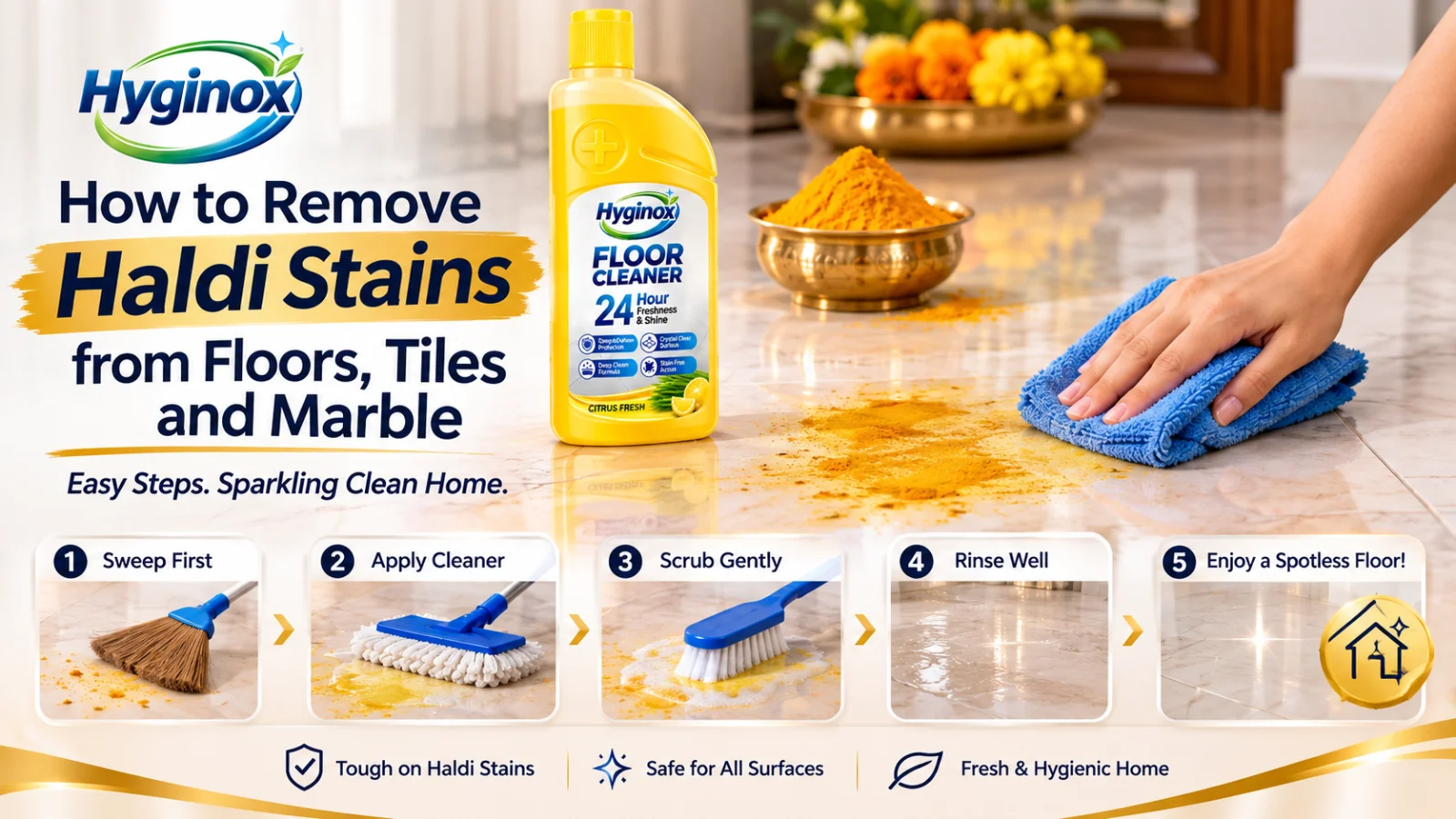
Knowing how to remove haldi stains from floor surfaces is one of the most useful things a household can learn before a wedding. A haldi ceremony means yellow paste, laughter, and a lot of spills on the very floors you want to keep clean. The stain itself is not hard to remove if you act early and use the right method for your floor. The trouble starts when the wrong hack is tried first: a stain that turns red after soap or baking soda, or a lemon that etches marble. This guide explains why haldi stains behave the way they do and what to do on each kind of surface.
It is written for Indian homes, so it covers vitrified and ceramic tiles, grout, marble, granite, vinyl, laminate, anti-skid tiles and kitchen counters. It also covers the part most guides skip: haldi usually leaves two stains, not one.
In short, if you are short on time and need to know how to remove haldi stains from floor tiles before guests arrive: blot, lift any oil, rinse with mild soap, and avoid lemon on stone.
Why haldi stains stick to floors
The yellow in haldi is curcumin, a strong natural dye. It clings to anything porous, which is why a spill that wipes off glazed tile can stain grout, unsealed stone or an unglazed tile permanently if it is left to dry. Haldi used at a ceremony is also rarely dry powder. It is usually mixed into a paste with oil, milk or water, and that paste spreads further and soaks deeper than dry spice would.
Three things decide how hard a haldi stain will be: how porous your floor is, how long the paste has been sitting, and whether oil came with it. Glazed vitrified tile is the easiest. Grout, marble and other natural stone are harder, because they absorb liquids. Knowing this helps you decide how to remove haldi stains from floor types that behave very differently.
Before the haldi function: protect your floors
The easiest way to remove haldi stains from floor surfaces is to stop them reaching the floor at all. If you are hosting the ceremony at home, a few minutes of preparation saves hours later.
- Cover the floor where the ceremony happens. Use plastic sheets, old bedsheets, or a large mat, and tape the edges so they do not slide. Plastic under cloth works better than cloth alone, because paste can soak through fabric.
- Use trays and bowls with raised edges for the haldi paste, so drips fall on the tray and not the floor.
- Prefer a terrace, courtyard or balcony if you can, where a hose-down is easy. Check the surface first, because textured outdoor tiles hold paste in their grooves.
- Keep paste off the stairs and the entrance. People walk through with haldi on their feet and hands, so keep a bucket of water, a towel and a doormat at the exit of the ceremony area.
- Keep a cleaning kit ready: clean damp cloths, paper towels, mild dish soap, a soft brush and a plastic scraper.
How to remove haldi stains from floor surfaces: the first 10 minutes
For a fresh spill, speed matters more than the product. These steps work on most sealed floors, including glazed tile and vitrified tile.
- Blot, do not rub. Press paper towels or a clean cloth on the spill to lift as much paste as you can. Rubbing pushes haldi into pores and grout. The Natural Stone Institute gives the same advice for any spill on stone: blot rather than wipe, because wiping spreads it.
- Scrape off thick paste. Use a plastic scraper or an old card, never a metal blade.
- Wipe with a damp cloth. Rinse the cloth often, because a cloth that is already yellow just spreads colour around.
- Use a mild detergent solution. A few drops of dish soap in warm water, applied with a soft cloth, removes most fresh haldi from sealed surfaces.
- Rinse with plain water and dry. A film of soap left on the floor can hold colour and dirt.
- Check in daylight. A faint yellow tint is easier to see in natural light than under a ceiling bulb.
If you see a red or orange tint after the soap step, do not panic. That is a known reaction explained in a later section, and it does not mean the stain is permanent.
Haldi usually leaves two stains: oil and colour
When you work out how to remove haldi stains from floor spills, this is the point most guides miss. A haldi ceremony paste often contains oil, so a single spill can leave an oil stain and a colour stain together. They need different treatment, and the order matters.
- Deal with the oil first. Blot, then cover the area with baking soda to absorb oil and brush it away. For old oil on stone or porous tile, the Natural Stone Institute recommends a poultice: a paste of baking soda and water, spread about a quarter to half an inch thick, covered with plastic and left to dry for 24 to 48 hours. See our guide to removing lamp oil and ghee stains for the full method.
- Then deal with the colour. Once the oil has gone, the remaining yellow is the dye. Use the surface-specific methods below.
If you try to remove the colour first, oil left behind can hold the dye in place, and the stain seems to come back after it dries.
Why your haldi stain turned red (and what to do)
A common complaint when people try how to remove haldi stains from floor tiles is that a haldi stain turned red or orange after soap, baking soda or a detergent. This is chemistry, not a new stain. InstaCuppa's turmeric stain guide explains that curcumin turns red at roughly pH 7.5 to 8.5, which is where soap and baking soda sit. The colour change is real, but it is a temporary shift in the dye, not extra staining.
What to do:
- Keep rinsing with plain water. The red usually fades as the alkaline product is rinsed out.
- Do not keep adding baking soda or soap on top of a red stain, because that holds the dye in its red form.
- Remove as much dye as you can mechanically, by blotting and rinsing, before you reach for any product.
- If a yellow or orange mark remains on stone, use the gentle stone method below.
Why the baking soda and lemon hack can backfire
Search for how to remove haldi stains from floor surfaces and you will find a popular tip: make a paste of baking soda, add lemon, leave it, and scrub. It sounds sensible, but it has two problems.
- Lemon is acidic. The Natural Stone Institute warns that lemon, vinegar and other acids may dull or etch calcium-based stone such as marble. An etch mark is permanent surface damage, and it will look worse than the stain you were trying to remove.
- Baking soda is alkaline. It can turn the haldi red, which makes people think the stain has got worse.
Baking soda by itself is still useful on sealed tile, where it is gentle on the glaze. Just rinse thoroughly and expect a brief colour shift. Skip the lemon completely on marble and granite.
How to remove haldi stains from floor types: a surface guide
The same stain needs a different approach depending on what is underfoot. Test any method on a hidden corner first.
| Surface | What to do | Avoid |
|---|---|---|
| Glazed vitrified and ceramic tile | Blot, damp cloth, mild dish soap solution, rinse and dry. For a leftover tint, a short-contact baking soda paste, then rinse well. | Abrasive pads, which dull the glaze |
| Grout | Soft brush with mild detergent, rinse repeatedly. See below for stubborn stains. | Wire brushes, which wear grout away |
| Marble | Blot at once, mild soap and water, rinse and dry. For stubborn colour, a hydrogen peroxide poultice on light stone, after a patch test. | Lemon, vinegar, floor acid and toilet cleaners |
| Granite | Blot at once, mild soap and water, rinse and dry. Poultice for stubborn marks. | Acidic cleaners and abrasive pads |
| Vinyl and PVC | Damp cloth and mild dish soap, rinse and dry. Use baking soda paste only briefly if a tint remains. | Abrasive scrubbers and harsh solvents |
| Laminate | Wipe quickly with a damp, well-wrung cloth and mild soap, then dry. Use very little water. | Soaking the floor, and abrasive or harsh cleaners |
| Anti-skid and textured tile | Work a soft brush along the grooves with mild detergent, then rinse well. | Skipping the brush, so paste stays in the texture |
| Painted walls | Dab with a damp cloth and a little mild soap, without scrubbing, after a patch test. | Rubbing hard, which polishes the paint and spreads the mark |
For flooring maker EGGER, the rule for laminate is to use a damp mop, never excessive water or standing water, and to avoid harsh or abrasive cleaners. Their laminate cleaning advice is worth reading if that is your floor.
Haldi stains on marble and granite: gentle first, then stronger
Marble and granite need more care, because they are porous and marble is acid-sensitive. Our guides on how to clean marble floors and how to clean granite and marble floors safely cover the basics. Here is how to remove haldi stains from floor stone such as marble and granite:
- Blot and rinse straight away. Use mild soap and water, then rinse and dry.
- Give it time. The Natural Stone Institute notes that organic stains, such as those from coffee, tea and fruit, may fade once the source is removed. Turmeric is also an organic stain, so a mild mark may lighten over a few days of normal cleaning.
- Try a baking soda paste for light marks. One marble care guide, from World of Stones, suggests a thick paste left for 20 to 30 minutes and wiped off gently. Expect a brief red tint, and rinse well.
- For stubborn colour on light stone, consider hydrogen peroxide. The same guide describes soaking a cotton ball in hydrogen peroxide, placing it on the stain, covering it with plastic wrap for several hours, then rinsing, and says to use it only on white or light marble. The Natural Stone Institute's stain guidance names a strong, hair-bleach-strength peroxide with a few drops of ammonia for organic stains, applied as a poultice.
Safety note: strong peroxide and ammonia are hazardous. Ventilate the room, wear gloves and eye protection, keep children and pets away, and never mix peroxide, ammonia and bleach. Pharmacy-strength peroxide is milder and slower. If the floor is valuable, dark-coloured or heavily stained, call a stone restorer instead of experimenting.
Haldi stains on grout
Grout is porous and often lightly textured, so haldi can sit in it long after the tile has been wiped clean. To remove haldi stains from floor grout, use a soft brush and a mild detergent solution, scrub along the grout line, rinse repeatedly and dry. If the stain is still there, repeat rather than escalating. Avoid wire brushes, which wear the grout away. For more on caring for grout, see our guide to cleaning grout without damaging tiles. If the grout is old and has lost its seal, it will stain easily, and sealing or regrouting may be the long-term fix.
Haldi stains on kitchen counters and backsplash
Haldi in the kitchen is a daily problem, not just a wedding one. Counters and backsplash tiles pick up yellow from cooking. The same steps for how to remove haldi stains from floor tiles work on backsplash tiles. On sealed laminate and tile, a wipe with mild dish soap and water usually works, and a brief baking soda paste can handle a leftover tint. On marble or granite counters, avoid vinegar and lemon, exactly as you would on a floor. If oil is part of the mark, see our kitchen grease stain guide.
What not to use on haldi stains
- Vinegar or lemon on marble and granite. They etch the stone.
- Bleach mixed with ammonia, or with any other cleaner. The Natural Stone Institute warns that this produces a toxic gas.
- Metal blades and steel wool. They scratch glaze and polish.
- Layers of baking soda or soap on top of a red stain. This keeps the dye red.
- Lots of water on laminate and wood. Standing water damages seams.
- Waiting. A haldi stain that has dried and soaked in is much harder to remove than a fresh spill.
Sunlight is sometimes suggested as a free stain remover. Sources disagree: one guide says light breaks turmeric down on movable items such as plastic containers, while a stone guide says turmeric darkens in sunlight. It is not a reliable method for floors, so do not depend on it.
After the function: a quick clean-up checklist
- Remove plastic sheets and mats carefully, folding the dirty side inward.
- Sweep up dry petals, powder and food crumbs before using water.
- Treat oil first, then colour. This is the core of how to remove haldi stains from floor spills after a function.
- Mop the whole area with a diluted floor cleaner suited to your floor, rinse with plain water and dry.
- Check grout lines and the edges of the area in daylight.
- For general festive clean-up, our post-Diwali cleaning tips include a section on rangoli colour and diya oil that works for similar spills.
Wedding season runs through late November and December this year, with muhurat dates listed on Aza Fashions' wedding date guide. Check your own panchang, because dates differ by region.
Where Hyginox Floor Cleaner fits
Full disclosure: Hyginox makes this product, so use your own judgment. A floor cleaner is the finishing step in how to remove haldi stains from floor spills, not a replacement for blotting, oil removal or a poultice. Hyginox Floor Cleaner is labelled as a multi-surface formula for tile, marble, granite and vitrified floors, and the product page directs 2 capfuls in a bucket of clean water. It comes in 500 ml, 1 L and 5 L packs. Test a hidden corner first, rinse with plain water afterwards, and check the label if your floor is laminate, vinyl or wood, which are not listed. If you are comparing products, our guide to the best floor cleaner in India explains what to look for.
Final takeaway
Knowing how to remove haldi stains from floor surfaces comes down to a few habits: act fast, blot instead of rubbing, lift any oil first, and treat the colour by surface. Remember that red is a temporary reaction, not a worse stain, and keep lemon and vinegar away from marble and granite. Protect the floor before the ceremony, and the clean-up afterwards will take minutes instead of days.