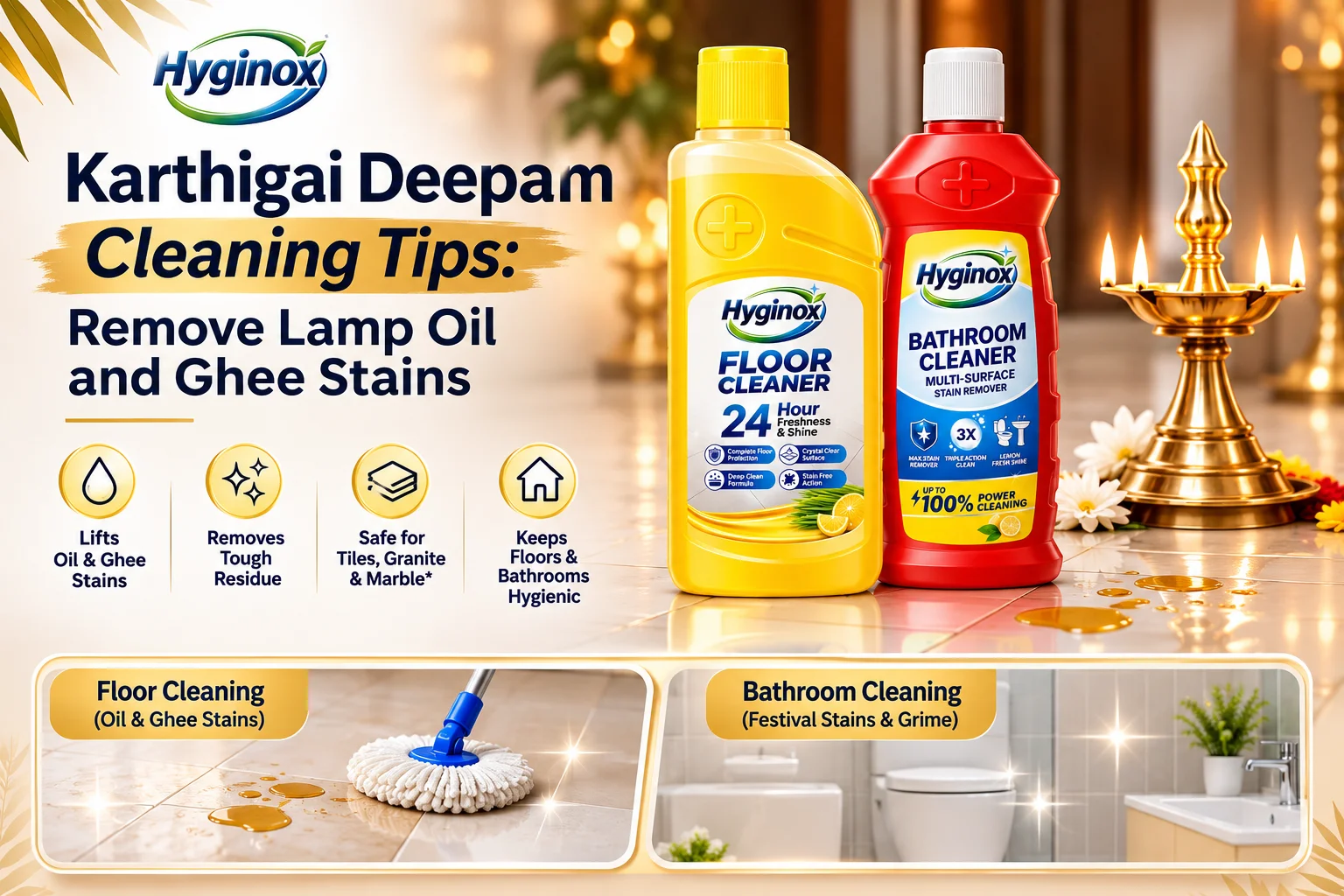
These Karthigai Deepam cleaning tips show you how to protect your floors before the lamps are lit and how to remove lamp oil, ghee, wax and kolam colour afterwards. Karthigai Deepam fills the threshold, steps, windows and shrine with rows of agal vilakku lamps, and every lamp that tips over, overflows or drips leaves a mark. Oil sinks into tile and stone faster than most people expect, so what you do in the first few minutes matters more than whatever you scrub with later.
This guide is written for homes in Tamil Nadu and Kerala, and for Telugu and Kannada households that light lamps through Karthika Masam. It covers marble, granite, vitrified, ceramic and unglazed tiles, and gives separate steps for fresh spills and old, soaked-in stains, so you can use the right method for the floor you actually have.
When is Karthigai Deepam in 2026, and why does it matter for your floors?
According to Drik Panchang, Karthigai Deepam falls on Tuesday 24 November 2026. The same day is Thrikarthika in Kerala and Karthika Pournami in Andhra Pradesh and Telangana. Karthika Masam, the month of lamps in the Telugu and Kannada calendars, runs from 10 November to 8 December. Regional panchangs can differ by a day, so check the one your family follows.
Traditionally, families clean the house and the entrance in the afternoon, draw a kolam at the doorstep, light the shrine lamp first and then carry the flame to the other lamps at dusk. As HinduTone's Karthigai Deepam guide describes it, clay lamps with sesame oil or ghee and cotton wicks are placed at the shrine, the threshold, the windows and the steps. That puts open oil on exactly the surfaces people walk on, which is where stains are hardest to hide and most likely to be stepped on and spread.
The good news is that lamp oil is a predictable problem. You know where the lamps will be, you know when they will be lit, and you know the stain you are likely to get. A little preparation and the right order of steps, which is what these Karthigai Deepam cleaning tips give you, will keep almost all of it off your floors.
What lamp lighting leaves behind on floors
Oil and ghee
A drip of sesame oil or ghee looks small on a glazed vitrified tile, but on marble, granite and unglazed tiles it soaks in and darkens the surface. The Natural Stone Institute explains that oil-based stains darken natural stone and have to be dissolved before they can be rinsed away, which is why a quick pass with a mop often does not remove them. Ghee has another problem: as it cools it can set into a waxy film that traps dust and shows up as a dull, greasy patch.
Wax and soot
Some homes also light wax lamps or candles alongside the clay ones, and wax drips harden quickly on a cool floor. Wicks that burn unevenly leave soot on window sills, grills and the wall above the lamp. Soot is dry and powdery at first, so it should not be wiped with a wet cloth straight away.
Kolam colour
Rice-flour kolams sweep away easily when they are dry. Coloured powders are different: they can leave pigment behind on damp or porous surfaces, especially when footprints, spilled water or lamp oil have wet them. If your doorstep kolam is coloured, plan to clean it as carefully as the oil.
Karthigai Deepam cleaning tips before you light the lamps
The easiest stain to remove is the one that never happens. These Karthigai Deepam cleaning tips for the afternoon before the festival take about fifteen minutes and prevent most of the damage.
- Clean and dry the floor first. Do the traditional afternoon clean of the house and entrance, then let the floor dry completely. Lamps placed on a wet floor slide easily, and a tipped lamp spreads oil across the wet surface.
- Put every lamp on a tray or plate. A metal plate or tray with a slightly raised edge catches drips and overflow. This matters most on marble and granite thresholds and steps.
- Do not fill lamps to the brim. Fill them to about three-quarters so oil does not overflow when a lamp is lifted, moved or knocked.
- Keep a small spill kit nearby. A dry cotton cloth or paper towels, a bowl of baking soda, a soft brush and a plastic scraper are enough. Having these at hand means you can act within seconds.
- Keep lamps away from curtains, door mats and children's play areas. This is a fire safety point first, but it also keeps oil away from fabric and rugs that are harder to clean than a floor.
- Sweep the kolam dry. If the kolam is made with coloured powder, avoid placing lamps right on top of it, because oil turns the powder into a paste.
Karthigai Deepam cleaning tips for removing fresh lamp oil and ghee from floors
Speed and order are what matter for a fresh spill. Follow these steps in sequence and do not skip the blotting.
- Blot, do not wipe. Press a dry cloth or paper towel on the spill and lift. The Natural Stone Institute specifically warns against wiping, because wiping spreads the spill across a bigger area.
- Cover the spot with baking soda. Sprinkle a thin, even layer over the remaining oil and leave it for 20 to 30 minutes. The powder absorbs oil that the cloth could not lift.
- Brush it up. Sweep the powder into a dustpan with a soft brush. Do not rub it in, and do not use a wet mop on it yet.
- Mop with a diluted floor cleaner. Use a cleaner that is suitable for your floor type, diluted as the label directs. A damp microfibre mop is better than a wet one, because standing water can carry oil into grout and stone.
- Rinse and dry. Go over the area once with plain water, then dry with a clean cloth. Skipping this step leaves a film that can feel sticky and attract dust.
- Check in daylight. Oil stains are easier to see in daylight, and a dark or dull patch that remains means you need the stronger method below.
If the spill is ghee that has already set, use a plastic scraper to lift the solid part gently before you start, and never use a metal blade on tile or stone. For more on handling cooking oil and ghee in the kitchen itself, see our kitchen grease stain guide.
Karthigai Deepam cleaning tips for old oil stains on marble, granite and porous tiles
When oil has been sitting for hours or days, it has already gone below the surface. Scrubbing harder will not help and can damage the finish. The method the Natural Stone Institute recommends for oil-based stains on stone is a poultice, which is a paste that draws the oil out as it dries.
- Clean the area first. Wipe off any surface residue with a damp cloth and a few drops of mild soap, then dry.
- Make the paste. Mix baking soda with a little water until it forms a thick paste, about the consistency of peanut butter.
- Apply it generously. Spread the paste about a quarter to half an inch (roughly 6 to 12 mm) thick, extending a little beyond the edges of the stain.
- Cover and wait. Cover the paste with plastic wrap, tape the edges down, and leave it for 24 to 48 hours. As the paste dries, it pulls the oil out of the stone.
- Remove and rinse. Take off the plastic, scrape the dry paste away with a plastic tool, rinse with clean water, and dry the floor.
- Repeat if needed. Stubborn stains may need more than one application, and the Institute notes that difficult stains can take several rounds.
Do not use vinegar, lemon or any acidic cleaner on marble or granite to remove oil. The Natural Stone Institute's care guidance warns that acids dull and etch calcium-based stone, and an etch mark is permanent surface damage that no amount of poultice will fix. See our guides on how to clean marble floors and how to clean granite and marble floors safely for more detail on what is safe on stone. If the stain is still there after several rounds, or the floor is a valuable natural stone, call a stone restorer rather than trying stronger chemicals.
How to remove wax and soot after the lamps burn down
Wax drips
Wait for the wax to harden fully. Then lift it with a plastic scraper or an old plastic card, working at a low angle so you do not scratch the floor. Wipe off the thin film left behind with a damp cloth and a little diluted floor cleaner, and dry the area. Never use a metal knife or heat on a stone floor.
Soot on sills, grills and walls
Start dry. Wipe soot off window sills and grills with a soft, dry cloth or a vacuum brush before using any water, because a wet cloth pushes soot into a grey smear. Then follow with a damp cloth and a mild cleaner. On painted walls, test a small hidden patch first and dab gently rather than scrubbing.
Karthigai Deepam cleaning tips by floor type
The same oil spill needs a different response depending on what is underfoot. Use this table to match the method to your floor.
| Floor type | Fresh oil or ghee | Old or soaked-in stain | Avoid |
|---|---|---|---|
| Vitrified and glazed ceramic tiles | Blot, baking soda, damp mop with diluted floor cleaner, rinse | Repeat the absorb-and-mop steps once or twice | Abrasive pads and heavy scrubbing that dull the glaze |
| Marble | Blot at once, baking soda, damp mop with a non-acidic cleaner | Baking-soda poultice for 24 to 48 hours, after a patch test | Vinegar, lemon, floor acid and toilet cleaners |
| Granite | Blot at once, baking soda, damp mop with a neutral cleaner | Baking-soda poultice, repeated if needed | Acidic cleaners and abrasive pads |
| Unglazed, handmade or traditional tiles | Act within minutes, because these absorb oil faster | Poultice after a patch test, or ask a professional | Soaking the area with water, which spreads oil into the tile |
| Anti-skid and textured tiles | Blot, then work a soft brush along the grooves | Brush with baking soda paste, then rinse well | Skipping the rinse, which leaves residue in the texture |
How to clean kolam colour and the threshold
The kolam and the lamps usually share the same doorstep, so these Karthigai Deepam cleaning tips for the threshold cover both stains. Sweep the dry kolam powder away first with a soft broom. Then wipe the area with a damp cloth that you rinse often, because a cloth that stays coloured just spreads pigment around. If colour has set into a porous surface, use a gentle diluted floor cleaner and a soft brush, then rinse and dry.
Our post-Diwali cleaning tips include a full section on removing rangoli colour and diya oil and wax from floors. The method is the same for kolam, so it is worth reading if the colour does not come out on the first try. For stone thresholds, apply the same rules as for marble and granite floors: neutral cleaner, no acids, and dry the stone when you finish.
If you light lamps every evening during Karthika Masam
Many families light lamps daily through Karthika Masam or the Karthigai month, not just on the festival day. Small drips repeat every evening and build into a visible film. These Karthigai Deepam cleaning tips work for daily lamps too, with a shorter routine that prevents this.
- Same-night wipe: after the lamps are out and cool, blot any drips and wipe the tray, the plate and the floor around them.
- Weekly mop: damp mop the threshold and steps with a diluted floor cleaner and rinse with plain water.
- Monthly check: look for dark rings or dull patches at the usual lamp spots, and treat them with the poultice method before they set deeper.
Using the same trays or plates every day also makes it obvious where oil gathers, and it is much quicker to clean a plate than a floor.
Cleaning the pooja room and kitchen after the festival
The pooja room usually has the most lamp use, so check its floor and the base of the lamp stand. Wipe the floor with a damp cloth, treat any spots with baking soda, and keep a mat or plate under each lamp stand.
Any list of Karthigai Deepam cleaning tips should include the kitchen, which takes a hit too. Festival food such as pori urundai and appam involves frying and ghee, so grease collects on the slab, the stove and the nearby floor. Wipe kitchen oil as you cook, then use our kitchen grease guide for the stove, the backsplash and the slab. Remember that the floor cleaner you use on the living room is meant for the floor, not for the stove.
Common mistakes when cleaning lamp oil from floors
Avoid these mistakes when you follow any Karthigai Deepam cleaning tips:
- Wiping instead of blotting. Wiping spreads a small spill into a larger stain.
- Using vinegar, lemon or floor acid on marble or granite. These etch the stone and leave a permanent dull mark.
- Flooding the area with water. Water can carry oil deeper into porous tile and grout.
- Scrubbing with steel wool or hard brushes. This scratches the glaze or polish and makes the floor stain faster next time.
- Adding extra cleaner "for more shine." Extra cleaner leaves a film, which feels sticky and holds dust.
- Mixing cleaners. The Natural Stone Institute warns that bleach and ammonia together produce a toxic gas, so never combine cleaning products.
- Leaving the stain until next week. Oil stains get harder to remove the longer they sit.
A simple checklist of Karthigai Deepam cleaning tips
The day before
- Sweep and mop floors and let them dry.
- Set out trays or plates for every lamp.
- Prepare the spill kit: cloth, baking soda, soft brush, plastic scraper.
On the evening of the festival
- Fill lamps to three-quarters and place them on trays.
- Blot any drip the moment you see it.
- Keep lamps away from curtains and children.
The next morning
- Let lamps cool and remove the trays.
- Treat any spots with baking soda, then mop with a diluted floor cleaner and rinse.
- Start a poultice on any dark patch that remains, and note the date.
Where Hyginox Floor Cleaner fits
Full disclosure: Hyginox makes this product, so use your own judgment. For the final mop in these Karthigai Deepam cleaning tips, Hyginox Floor Cleaner is labelled as a multi-surface formula for tile, marble, granite and vitrified floors, and the product page directs 2 capfuls in a bucket of clean water. It comes in 500 ml, 1 L and 5 L packs. Always test a hidden corner first, and remember the order matters: blot and absorb the oil first, then mop. A floor cleaner finishes the job, but it does not replace blotting or a poultice for old oil stains. If you are comparing products, our guide to the best floor cleaner in India explains how to check surface compatibility, dilution and residue.
Final takeaway
The best Karthigai Deepam cleaning tips come down to three habits: put every lamp on a tray, blot spills at once instead of wiping, and use a poultice rather than acid or force on old oil stains. Clean in the afternoon, mop with a suitable cleaner, rinse, and dry. Do that and your floors will look as good after the festival as they did before it, so you can enjoy the lamps instead of worrying about the oil.
Hyginox Bathroom Cleaner